


From Blacksmith to Modern Profession: Evolution of Welding | American Welding Academy
Every welding career tells a story—one that stretches back thousands of years from the village blacksmith's trade to today's sophisticated industrial workshops. What began as a hands-on craft has evolved into a profession defined by precision, standardized procedures, and advanced technology. The transformation wasn't sudden; it was driven by breakthroughs in materials science, electricity, and the relentless demand for stronger, faster, and more reliable metal joining methods.
Ancient Roots: Forge Welding and the Blacksmith's Legacy
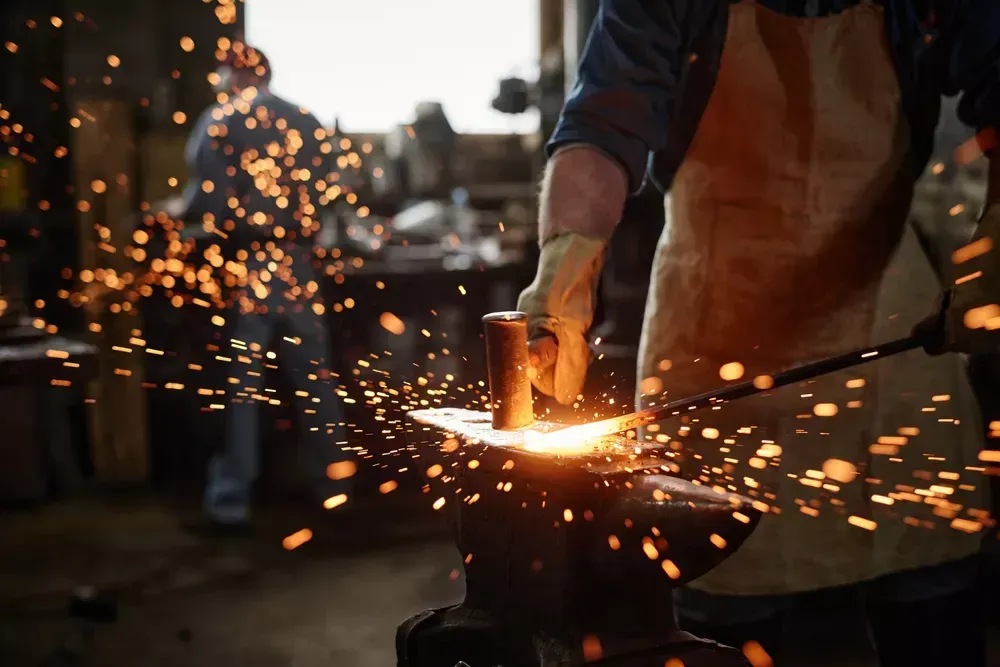
Long before electricity-powered workshops, welding existed in a form that looked more like cooking than modern machining. Ancient metalworkers heated metal until it became workable, then hammered pieces together until they bonded—a technique that required years to master.
Archaeological evidence shows that forge welding is far older than many realize. Discoveries in Egypt date metalworking back to approximately 3,000 B.C.
Evidence of metal joining under heat and force appears throughout the Eastern Mediterranean, with blacksmiths refining these techniques through the Middle Ages and beyond.
In every community, the blacksmith's forge became the practical center of daily life. This wasn't glamorous work—it was essential. Blacksmiths repaired tools, fabricated transport equipment, and created protective gear that societies needed to survive. Forge welding remained the dominant technique for centuries, matched to both the materials and equipment available at the time.
What makes this early phase important for understanding a welding career today is that it introduced the core principle underlying every modern process: joining two pieces of metal under controlled heat and pressure to create a bond stronger than the original materials. That fundamental truth hasn't changed.
From Flames To Electricity: The Industrial Revolution In Metal Joining
The 1800s and early 1900s triggered a revolution that lifted welding from the village shop and planted it firmly in industrial manufacturing. Two discoveries changed everything:
The Gas Era
In 1836, Edmund Davy discovered acetylene. Though the gas itself was known earlier, practical equipment and production methods didn't emerge until years later. Once they did, oxy-acetylene welding became a game-changer. It offered metalworkers a controllable, portable heat source that didn't depend on a blacksmith's forge.
The Electrical Revolution
Electricity brought even more dramatic change. The first practical arc welding process emerged in the early 1880s, developed by Nikolai Benardos and Stanislaw Olszewski. By 1916, oxy-acetylene methods were well established, and many techniques from that era remain in use today despite ongoing advances in equipment and safety.
However, early bare-wire arc methods had a critical weakness: the molten metal wasn't adequately protected from the surrounding air. This pushed inventors to develop better shielding techniques. The world wars accelerated this innovation dramatically. The military's demand for reliable, economical joining methods drove improvements in both processes and protective procedures that shaped modern welding.
Standardization, Safety, and the Birth of a Profession
As welding spread across industries such as shipbuilding, pipeline construction, and pressure systems, raw skill wasn't enough anymore. Consistency and dependability mattered more than ever.
This need for standardized, verifiable procedures gave rise to professional organizations and shared expectations:
The American Welding Society (AWS) was founded in 1919 in Philadelphia.
Comfort Avery Adams, whose work during wartime had highlighted the need for standardization, served as its first president.
The National Academy of Sciences documented Adams's role in bridging wartime committees and the new professional body.
Over the following decades, welding transformed from a craft defined by "good hands" into a profession measured by testable performance, documented procedures, and strict safety discipline. Post-WWII developments introduced multiple modern methods—high-energy processes, solid-state joining, and eventually automation and robotic welding in factory settings. Each advance built on the need for repeatability, traceability, and safety at scale.
This evolution fundamentally shaped what a welding career means today: it's not just about technique, it's about accountability.
Building a Welding Career in Today's Environment
Modern welders still benefit from the blacksmith-era instinct of "reading" materials and understanding how heat affects metal. But the day-to-day reality is far more technical: interpreting joint specifications, setting precise parameters, maintaining consistency across multiple positions and materials, and adapting to different situations.
Progress in a welding career comes through repetition with feedback, not shortcuts. Skills are built in layers, each one preparing you for the next level of complexity.
What most newcomers don't realize at first is that "welding" isn't a single process. It is a family of processes. Core techniques include:
SMAW (Stick) – the traditional, versatile method
GMAW (MIG) – fast and popular in fabrication
FCAW (Flux Core) – powerful for structural work
GTAW (TIG) – precise and suited for thin materials
Oxy-fuel cutting – still essential in many shops
Plasma arc cutting – modern, high-precision alternative
If you're considering this path, aim for a foundation you can prove under test conditions. Employers care about what you can produce when it counts, and certification matters. This mindset aligns with how the field evolved historically: major breakthroughs happened when joining became repeatable, verifiable, and safe at scale.
The Modern Welding Career: Training With Industry Expectations
The path from ancient forge to a modern welding career reflects one of humanity's most essential skills. Metal joining has always been about creating something stronger, safer, and more capable. Today, that same principle drives industries worth billions of dollars. It creates opportunities for skilled professionals who understand the precision of the craft.
Ready to take the first step toward a stable, rewarding career? The American Welding Academy offers comprehensive welding training programs designed to prepare you for real-world success. Choose from our 24-week Pipe Welding & Fitting Course or 12-week Fabrication Welding & Fitting Course, both led by world-class instructors who provide the hands-on experience and industry expertise employers demand.
With day and evening sessions available and new classes starting throughout the year, you can begin building your future on your schedule. Connect with us online or call (636)800-9353 to learn more about enrollment, program details, and how the American Welding Academy can help you launch a career that lasts.
