


Welding Inspector Careers: Quality Control & Inspection Paths | American Welding Academy
If you've spent time in the field and want to take your skills in a new direction, a career as a welding inspector might be the next right move. It's one of the most respected advancement paths in the trade, and it shifts your focus from performing welds to evaluating them.
What a Welding Inspector Actually Does
Welding inspectors examine completed welds for size, quality, and conformance to industry codes. They perform visual inspections and apply non-destructive testing (NDT) methods to verify structural integrity. The role demands sharp attention to detail and a deep understanding of welding processes, exactly the knowledge experienced welders already have.
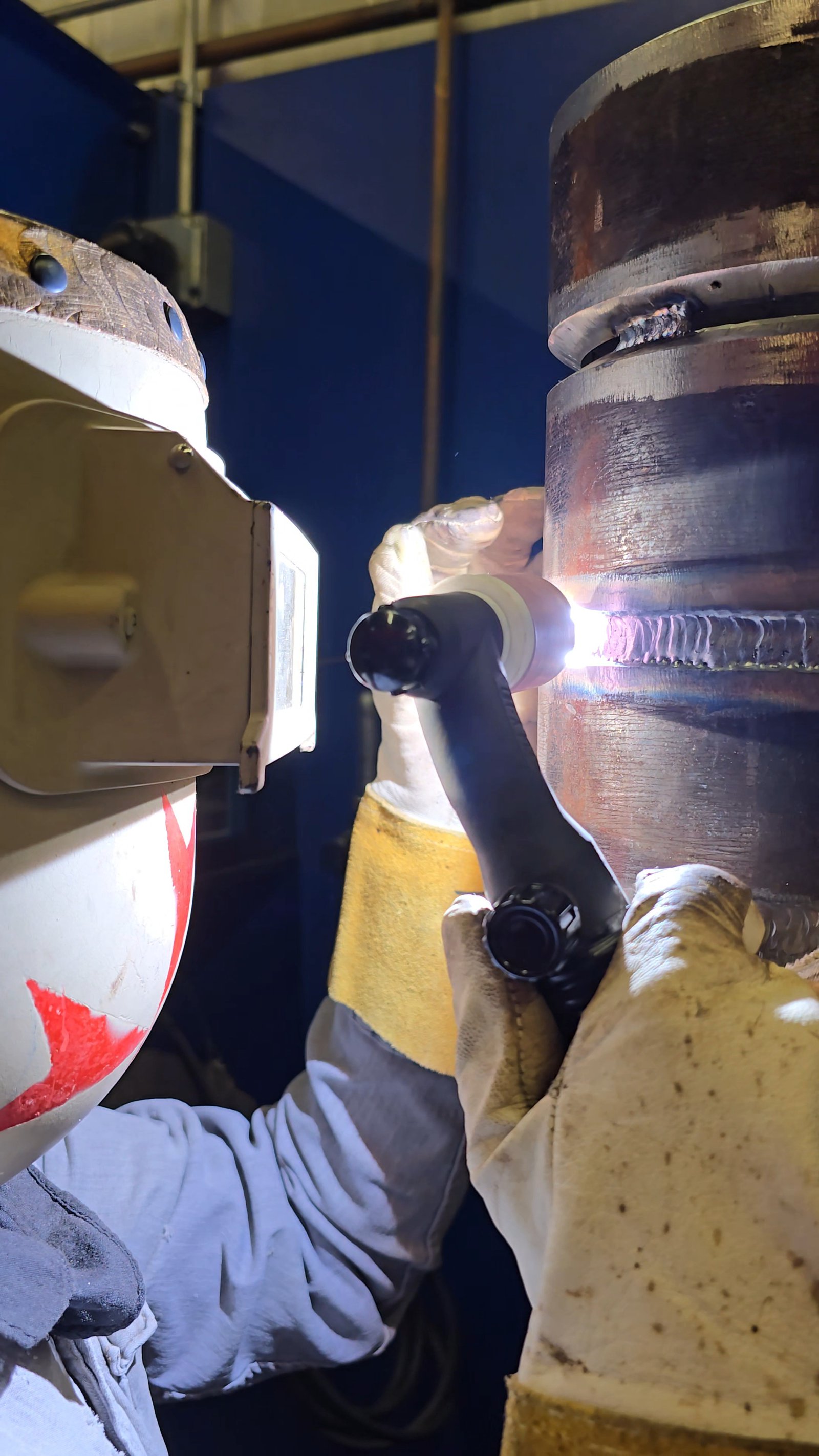
Here's what a typical welding inspector is responsible for:
Inspecting welds for cracks, pits, and dimensional accuracy
Reviewing and interpreting blueprints, weld procedure specifications (WPS), and procedure qualification records (PQR)
Applying NDT methods such as visual testing (VT), ultrasonic testing (UT), and magnetic particle testing (MT)
Verifying that all work meets applicable codes, such as AWS or ASME standards
Documenting inspection results and reporting non-conformances
The Welding Inspector Certification Path Worth Knowing
The most widely recognized credential in this field is the AWS Certified Welding Inspector (CWI) certification. Earning it requires passing a comprehensive exam covering welding fundamentals, code application, and practical inspection skills.
From there, the career ladder continues. Roles like Senior Certified Welding Inspector (SCWI) and Welding Quality Control Coordinator represent leadership-level positions that involve managing inspection teams and implementing quality assurance programs.
The typical path looks like this:
Start with hands-on welding experience across multiple processes
Study for and pass the AWS CWI exam
Build proficiency with inspection tools and NDT methods
Pursue additional NDT certifications (Level II or III)
Advance toward Senior Inspector or QC Coordinator roles
Compensation and Career Flexibility
Welding inspectors generally see strong earning potential compared to production welding roles. Entry-level inspectors tend to earn in the $50,000–$65,000 range, while a CWI credential can push that to $70,000–$90,000 annually. Senior inspectors working in high-risk sectors like oil and gas, nuclear, or aerospace may earn $95,000 or more.
Beyond the pay, the role offers real flexibility. Many welding inspection positions allow for contract or project-based work, meaning inspectors can take assignments across industries and regions. Travel-based opportunities, common in the pipeline, offshore, and energy sectors, often come with premium compensation in addition to base pay.
Why Your Welding Career Is the Foundation
Here's an important truth: you can't inspect what you don't understand. Employers and certification bodies expect welding inspectors to have genuine field experience before stepping into a quality control role. The technical credibility you build as a welder directly informs your ability to catch defects others might miss.
A welding career path isn't linear. Many experienced welders move into inspection part-time while still working the floor, building their credential portfolio before making a full transition. Others pursue supervisory or coordinator roles that blend both hands-on oversight and quality management. Either way, your time in the booth is never wasted.
Start With the Right Foundation at American Welding Academy
If you're still building your base skills, the welding career you want starts with solid, code-standard training. At American Welding Academy, every student earns their certifications. AWA's programs are built around AWS and ASME standards, the same benchmarks welding inspectors are tested on. Whether you enroll in the 24-week Pipe Welding & Fitting Course or the 12-week Fabrication Welding & Fitting Course, you walk away with recognized credentials and the hands-on foundation that advanced roles like inspection demand.awaweld+1
Ready to build the skills that open doors down the road? Visit www.awaweld.com or call American Welding Academy at (636) 800-9353 to learn more about enrollment and upcoming program start dates.
FAQ
Q: Do I need a college degree to become a welding inspector?
A: No degree is required for most entry-level inspection roles. A high school diploma or GED combined with welding experience and a CWI certification is the standard path. A post-secondary certificate or associate degree in welding or engineering technology can strengthen your application, but it is not mandatory.
Q: What is the difference between a CWI and an SCWI?
A: A Certified Welding Inspector (CWI) verifies that welds meet code and quality standards on the job. A Senior Certified Welding Inspector (SCWI) is an advanced credential for experienced CWIs. This often involves leadership responsibilities, procedure development, and more complex quality assurance work.
Q: Can welding inspectors work remotely or independently?
A: Some aspects of inspection work, such as reviewing documentation, writing reports, and developing quality procedures, can be done remotely. However, physical weld inspection still requires an on-site presence. Many inspectors work as independent contractors, choosing project assignments across various industries and locations.
